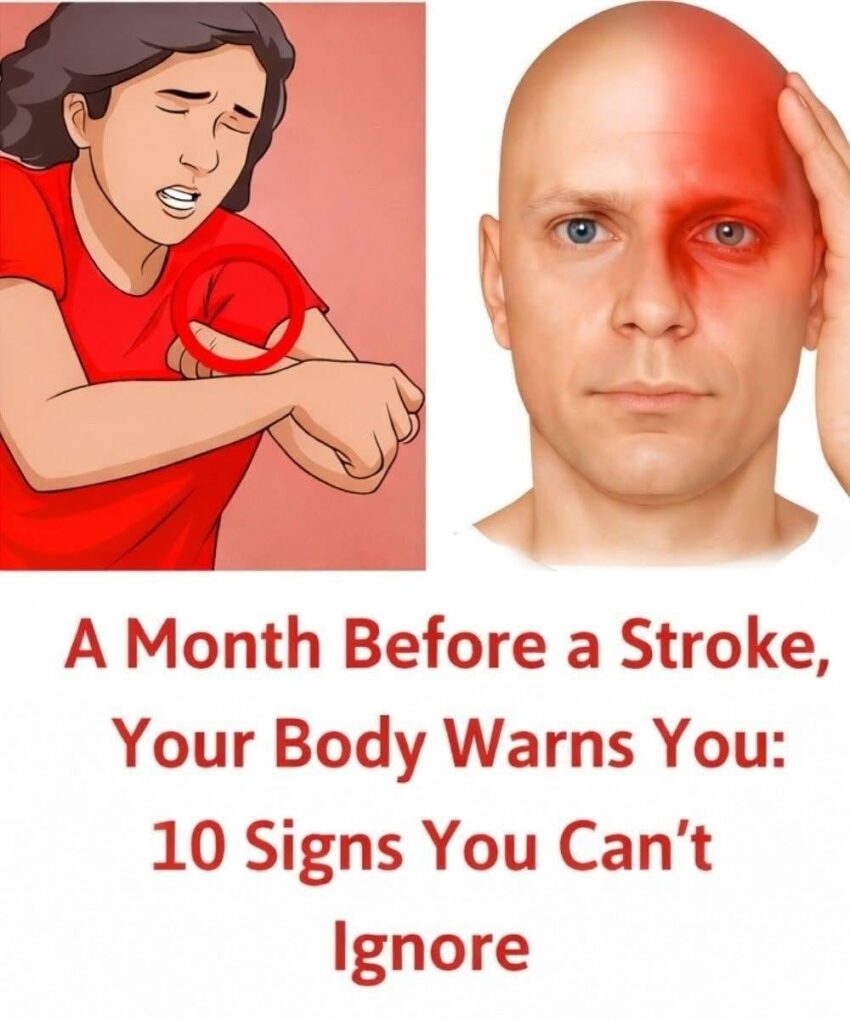
A Month Before a Stroke, Your Body Warns You? 10 Signs You Should Never Ignore
You may have seen headlines claiming that your body gives you exactly 10 warning signs one month before a stroke.
The reality is more complicated.
There is no reliable set of symptoms that can predict a stroke exactly one month in advance. However, some people experience a transient ischemic attack (TIA), sometimes called a “mini-stroke,” before a major stroke.
A TIA happens when blood flow to part of the brain is temporarily blocked. Its symptoms can disappear within minutes or hours, but it is still a medical emergency because it can be a warning that a major stroke may follow.
Here are 10 symptoms that should never be ignored.
1. Sudden Weakness or Numbness
Sudden weakness or numbness—especially on one side of the face, arm, or leg—is one of the most important warning signs.
Even if it disappears quickly, don’t simply assume everything is fine.
2. A Drooping Face
Ask the person to smile.
If one side of the face suddenly droops or feels numb, it may be a sign of stroke.
3. Sudden Trouble Speaking
Speech may suddenly become slurred, confused, or difficult to understand.
A person may also have trouble finding the right words or understanding what others are saying.
4. Sudden Vision Problems
A stroke or TIA can cause sudden vision loss or blurred or double vision in one or both eyes.
Because sudden vision changes can have several serious causes, they should be assessed urgently.
5. Sudden Difficulty Walking
Sudden dizziness, loss of balance, difficulty walking, or poor coordination can sometimes occur during a stroke.
Don’t ignore sudden problems with movement simply because they improve.
6. A Sudden Severe Headache
A sudden, extremely severe headache—particularly one that is unusual for the person—can be a warning sign of a serious neurological problem, including certain types of stroke.
It requires urgent medical evaluation.
7. Sudden Confusion
A person may suddenly become confused, have difficulty understanding simple questions, or seem unable to communicate normally.
A sudden change in mental function should never be dismissed as ordinary tiredness.
8. Sudden Difficulty Understanding Others
Stroke doesn’t only affect speaking.
A person may suddenly struggle to understand words, follow a conversation, or respond appropriately.
This can happen even when their hearing is normal.
9. Temporary Stroke-Like Symptoms
Perhaps the most important warning is a symptom that comes and then disappears.
For example, someone may suddenly experience weakness in one arm, difficulty speaking, or vision loss and then feel completely normal an hour later.
That could be a TIA.
Feeling better does not mean the danger has passed.
10. Repeated or Unexplained Neurological Episodes
Repeated episodes of sudden weakness, numbness, speech difficulty, vision changes, dizziness, or loss of coordination deserve medical attention.
There can be many causes for these symptoms, but a doctor needs to determine whether a TIA or another neurological condition is involved.
Remember FAST
One of the easiest ways to recognize common stroke symptoms is FAST:
F — Face: Does one side of the face droop?
A — Arms: Is one arm weak or numb?
S — Speech: Is speech slurred or difficult to understand?
T — Time: If these symptoms appear suddenly, seek emergency medical help immediately.
Some stroke organizations also emphasize additional symptoms such as sudden vision problems, severe headache, dizziness, or loss of balance.
Don’t Wait for Symptoms to Disappear
One of the biggest mistakes people make is waiting because the symptoms aren’t painful or because they disappear.
A TIA can be brief, but it can signal a serious risk of a future stroke.
If someone suddenly develops stroke symptoms, don’t drive them yourself and don’t wait to see whether they improve. Contact your local emergency medical service immediately.
Can You Prevent a Stroke?
You can’t prevent every stroke, but many risk factors can be managed.
Important steps include:
- Controlling high blood pressure
- Managing diabetes
- Avoiding smoking
- Maintaining a healthy weight
- Being physically active
- Following prescribed treatment for cholesterol or heart conditions
- Eating a balanced diet
- Taking prescribed medications as directed
Regular medical checkups can also help identify risk factors before they become serious problems.
The Bottom Line
There isn’t a scientifically proven list of “10 symptoms exactly one month before a stroke.”
But there are sudden symptoms that can signal a stroke or TIA, and recognizing them quickly can make a major difference.
If you or someone around you suddenly develops facial drooping, one-sided weakness, speech difficulty, vision problems, severe unexplained headache, or loss of balance, treat it as an emergency—even if the symptoms disappear.
When it comes to stroke, every minute matters.