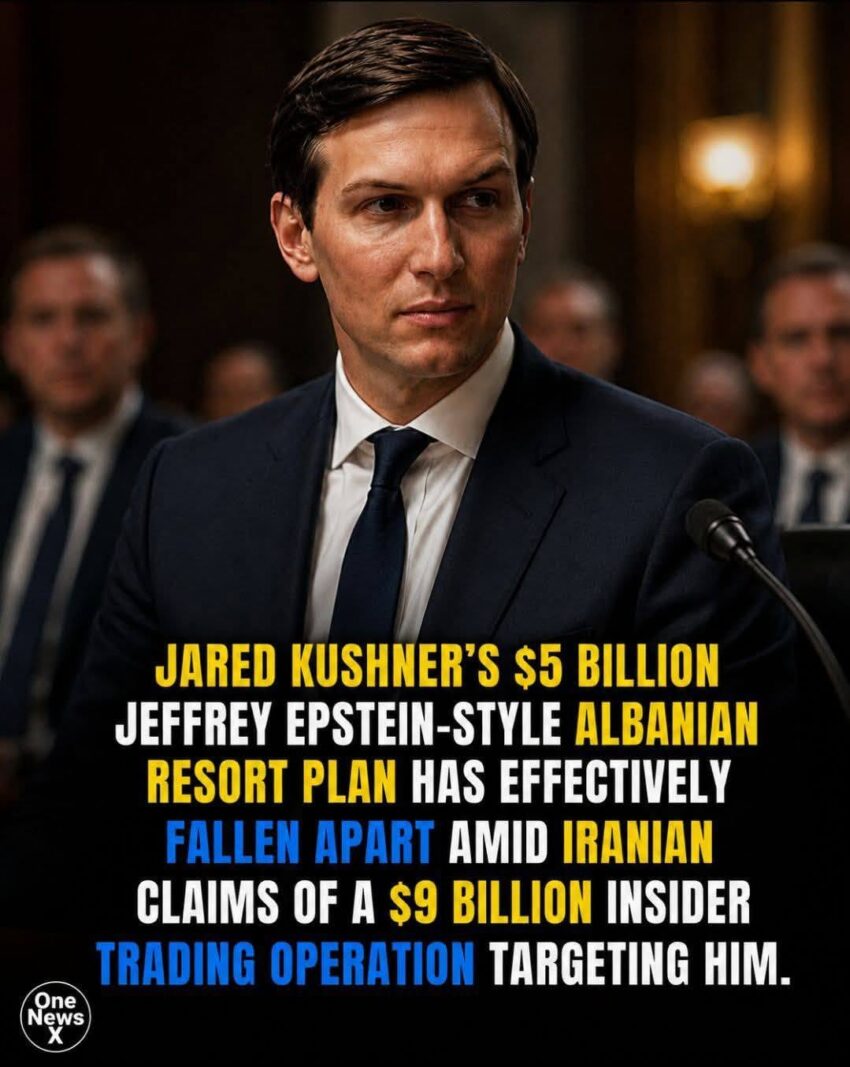
Jared Kushner’s Albanian Resort Project Faces Growing Backlash as New Allegations Surface
Jared Kushner’s plans for luxury developments along Albania’s Adriatic coast are facing mounting scrutiny, with protests, environmental concerns and questions about land ownership putting renewed pressure on the projects.
But before getting into the controversy, one important clarification is needed: the Albanian plans are not a single $5 billion resort.
Kushner’s investment firm, Affinity Partners, has been pursuing two major Albanian developments. One is a roughly $1.4 billion luxury resort on Sazan Island, while another proposed development in the Zvërnec area has been valued at around $4.7 billion. Together, the projects account for the figures approaching $6 billion that have circulated in reports.
And both have attracted serious opposition.
Why Are People Protesting?
The controversy is particularly intense around the planned development in the Vjosa-Narta protected landscape.
Environmental groups and local residents have raised concerns about construction in an ecologically sensitive coastal area that provides habitat for flamingos, seals and sea turtles.
Thousands of people have protested the projects, and demonstrations in Tirana have continued for months.
In July, tensions escalated when protesters clashed with police outside Albania’s Parliament. Police used water cannons and tear gas as some demonstrators threw eggs and bottles.
Critics argue that Albania is sacrificing protected coastal land in the pursuit of foreign investment.
Supporters of the development, including Prime Minister Edi Rama, have defended the projects and characterized some of the opposition as politically motivated.
Land-Ownership Questions Add Another Layer
The controversy isn’t limited to environmental concerns.
Recent reporting has raised questions about the land involved in the Zvërnec project.
A letter from local residents reportedly warned Kushner’s company about longstanding disputes over ownership before the deal was finalized.
The land has been associated with Artur Shehu, a businessman who has faced allegations involving money laundering, drug-trafficking connections and forged property documents.
Kushner’s company has said it was unaware of the alleged problems surrounding the property.
Albanian anti-corruption authorities have also been examining controversial changes involving protected areas and land ownership that helped make development possible.
These are serious allegations, but they should not be confused with findings that Kushner himself committed a crime. The existence of an investigation or allegations involving people connected to a project does not establish criminal wrongdoing by the project’s investors.
What About the $9 Billion Insider-Trading Allegation?
A separate and much more explosive claim has recently circulated.
According to reporting based on an account from a senior Iranian official, Iranian negotiators warned U.S. Vice President JD Vance that Kushner and Steve Witkoff were allegedly exploiting information from Middle East negotiations to profit from financial-market movements.
The Iranian side reportedly estimated that people with access to such information had made around $9 billion in profits.
The White House has denied the allegations.
That distinction is crucial.
The $9 billion figure is an allegation attributed to Iranian officials—not an established finding that Kushner personally made $9 billion through insider trading.
No evidence establishing that Kushner personally conducted an illegal $9 billion insider-trading operation has been presented in the sources reviewed for this story.
A Project Under a Much Bigger Spotlight
The Albanian resort controversy is therefore about more than luxury hotels.
It has become a debate over environmental protection, foreign investment, land ownership, political influence and the relationship between private business and powerful political figures.
Kushner’s projects remain at the center of that debate.
For now, however, the safest conclusion is that the developments are facing substantial political and public opposition, while some of the most sensational claims circulating online remain allegations rather than proven facts.
What happens next could determine not only whether the resorts are ultimately built, but also how Albania balances international investment with the protection of its coastline and the rights of local communities.