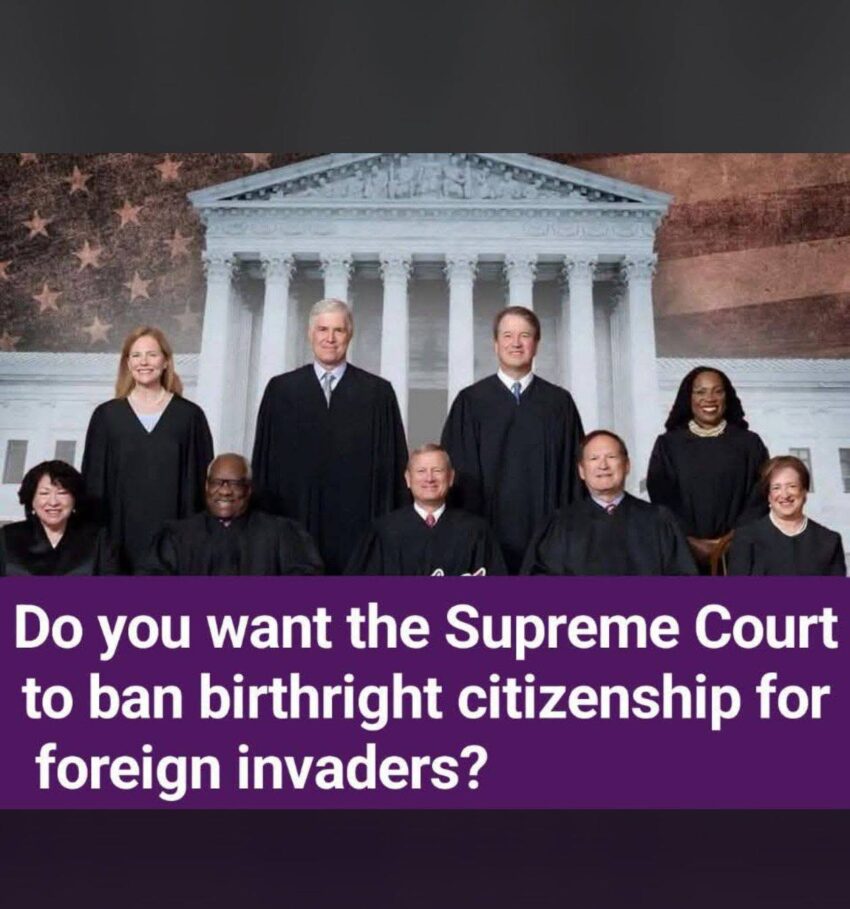
Birthright Citizenship and the Supreme Court: What Does the Constitution Actually Require?
The debate over birthright citizenship has become one of the most consequential questions in American constitutional law. At its center is a deceptively simple question: Does the Fourteenth Amendment guarantee U.S. citizenship to children born in the United States when their parents are not U.S. citizens, including parents who are unlawfully present?
The Supreme Court has now addressed that question directly.
The Constitutional Text
The starting point is the Citizenship Clause of the Fourteenth Amendment:
“All persons born or naturalized in the United States, and subject to the jurisdiction thereof, are citizens of the United States.”
The dispute turns largely on the meaning of the phrase “subject to the jurisdiction thereof.”
Supporters of restricting birthright citizenship have argued that this language does more than require physical birth on American soil. In their view, children whose parents lack permanent legal ties to the United States may not fall within the constitutional category of people fully subject to U.S. jurisdiction.
The opposing argument is that the phrase traditionally referred to whether the United States exercises sovereign authority over a person—not to the immigration status of the person’s parents.
The Historical Argument
The Supreme Court’s 2026 decision in Trump v. Barbara placed substantial weight on the historical meaning of citizenship.
The Court traced the Citizenship Clause to the English common-law principle known as jus soli, or citizenship based on birth within a sovereign’s territory. Under that tradition, people born within the sovereign’s territory generally acquired citizenship or subject status even when their parents were foreigners or were themselves subject to expulsion.
The Court concluded that the Fourteenth Amendment incorporated this territorial principle, subject to narrow historical exceptions such as children of foreign diplomats and certain other people outside ordinary U.S. jurisdiction.
This historical approach is important because constitutional interpretation often depends not only on the words of a provision but also on how those words were understood when they were adopted.
The Importance of Wong Kim Ark
Another major precedent is United States v. Wong Kim Ark, decided by the Supreme Court in 1898.
In that case, the Court held that a person born in the United States to Chinese parents was a U.S. citizen at birth. The Court interpreted the Fourteenth Amendment as confirming the longstanding principle of citizenship by birth on U.S. soil.
In Trump v. Barbara, the Court relied on Wong Kim Ark and rejected the argument that citizenship should depend on whether the child’s parents had established permanent domicile in the United States.
That precedent made the legal argument for a broad restriction particularly difficult: changing the rule would require either distinguishing or substantially limiting more than a century of constitutional precedent.
What About Undocumented Parents?
A central argument for restricting birthright citizenship is that parents who entered or remained in the United States unlawfully should not be able to create a constitutional entitlement for their children merely by giving birth on American soil.
The government’s position in the litigation emphasized parental status and the concept of allegiance. The argument was essentially that citizenship should reflect a sufficiently substantial connection between the family and the United States, rather than physical location alone.
The Supreme Court rejected that interpretation.
The Court held that children born in the United States to parents who are unlawfully or temporarily present are still “subject to the jurisdiction” of the United States. Consequently, those children are citizens at birth under the Citizenship Clause.
Could Congress Change the Rule?
There is an important distinction between changing ordinary immigration law and changing constitutional citizenship.
Congress has broad authority over immigration. But if birthright citizenship is constitutionally protected by the Fourteenth Amendment, ordinary legislation cannot simply contradict the Constitution.
The Court’s 2026 decision therefore matters beyond President Trump’s executive order. It establishes that the constitutional text itself protects citizenship for the children covered by the ruling.
A constitutional amendment would present a fundamentally different question, because an amendment could change the constitutional rule itself.
What Did the Supreme Court Actually Decide?
The Court’s holding in Trump v. Barbara was direct: children born in the United States to parents who are unlawfully or temporarily present are citizens at birth under the Fourteenth Amendment.
The decision affirmed the lower court’s judgment and rejected the legal theory behind Executive Order 14160, which sought to deny citizenship to specified categories of U.S.-born children.
The ruling was not unanimous. Chief Justice Roberts wrote for the Court, joined by Justices Sotomayor, Kagan, Barrett, and Jackson. Several justices wrote separately in dissent or concurrence.
The Larger Constitutional Question
The birthright-citizenship debate illustrates a broader disagreement about constitutional interpretation.
One approach emphasizes historical practice, precedent, and the broad language of the Citizenship Clause. Under that view, restricting citizenship based on the parents’ immigration status would require adding a qualification that the constitutional text does not contain.
Another approach gives greater weight to arguments about allegiance, parental status, national sovereignty, and the meaning of jurisdiction at the time the Fourteenth Amendment was adopted.
Those competing arguments are legitimate subjects of constitutional debate. But as a matter of current Supreme Court law, the question has been answered: the Fourteenth Amendment protects citizenship at birth for children born in the United States even when their parents are unlawfully or temporarily present.
The political debate may continue, but any future attempt to eliminate or substantially restrict birthright citizenship must now confront the constitutional holding of Trump v. Barbara and the Supreme Court’s longstanding interpretation of the Fourteenth Amendment.