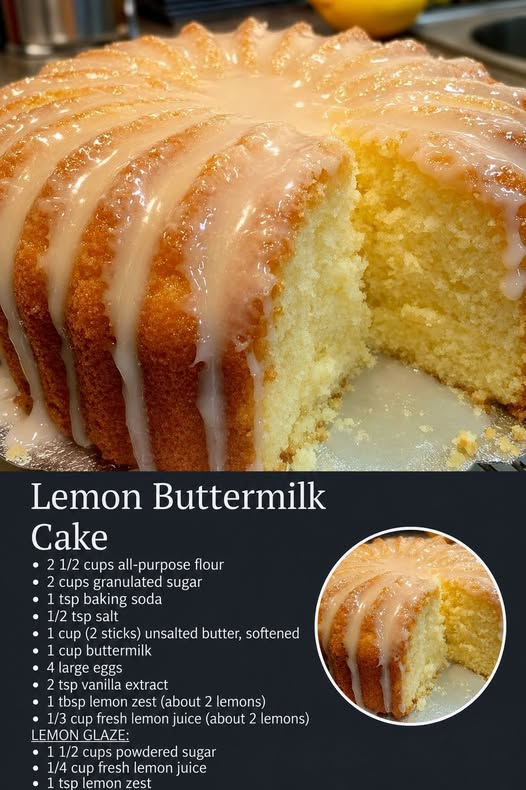
This Lemon Buttermilk Pound Cake is rich, buttery, tender, and bursting with fresh lemon flavor. Buttermilk gives the cake a wonderfully soft crumb, while fresh lemon zest and juice provide a bright citrus flavor that balances the richness.
Finished with a simple lemon glaze, this classic pound cake is perfect for afternoon tea, brunch, holidays, bake sales, or an everyday dessert.
Recipe Overview
- Prep Time: 20 minutes
- Bake Time: 65–75 minutes
- Cooling Time: 30–45 minutes
- Total Time: About 2 hours
- Servings: 12–16 slices
- Course: Dessert
- Difficulty: Easy to Moderate
Ingredients
For the Lemon Pound Cake
- 1 cup unsalted butter, softened
- 2½ cups granulated sugar
- 4 large eggs, room temperature
- 3 cups all-purpose flour
- ½ teaspoon baking powder
- ½ teaspoon baking soda
- ½ teaspoon salt
- 1 cup buttermilk, room temperature
- 2 tablespoons fresh lemon juice
- 2 tablespoons finely grated lemon zest
- 2 teaspoons vanilla extract
For the Lemon Glaze
- 1½ cups powdered sugar
- 3 tablespoons fresh lemon juice
- 1 tablespoon melted butter, optional
- 1 teaspoon finely grated lemon zest
How to Make Lemon Buttermilk Pound Cake
1. Prepare the Pan
Preheat the oven to 325°F (165°C).
Grease a 10-inch Bundt pan generously with butter or nonstick baking spray.
Dust lightly with flour, tapping out the excess.
Make sure you coat all the ridges and corners of the Bundt pan. This makes releasing the finished cake much easier.
2. Prepare the Lemon
Wash and dry the lemons thoroughly.
Finely grate the yellow outer layer of the peel.
Avoid grating too deeply into the white pith because it can taste bitter.
You need approximately 2 tablespoons of zest.
Then squeeze enough fresh lemon juice for the cake and glaze.
Fresh lemon juice gives this cake a much brighter flavor than bottled lemon juice.
3. Combine the Dry Ingredients
In a medium bowl, whisk together:
- Flour
- Baking powder
- Baking soda
- Salt
Set aside.
4. Cream the Butter and Sugar
Place the softened butter in a large mixing bowl.
Beat on medium speed for approximately 3–4 minutes, until very light and creamy.
Gradually add the granulated sugar.
Continue beating for another 3–5 minutes.
The mixture should become pale, fluffy, and noticeably lighter in texture.
This is one of the most important steps for creating a tender pound cake.
5. Add the Eggs
Add the eggs one at a time, beating well after each addition.
Scrape down the sides of the bowl as needed.
Add the vanilla extract and lemon zest.
Mix until combined.
6. Alternate Flour and Buttermilk
Add approximately one-third of the flour mixture to the butter mixture.
Mix on low speed just until incorporated.
Add half of the buttermilk.
Mix gently.
Continue alternating:
Flour → Buttermilk → Flour → Buttermilk → Flour
Finish with the flour mixture.
Add the fresh lemon juice and mix just until incorporated.
Important:
Don’t overmix the batter after adding the flour.
Overmixing develops gluten and can make the pound cake heavier and tougher than intended.
7. Fill the Bundt Pan
Pour the batter evenly into the prepared Bundt pan.
Use a spatula to smooth the top.
Gently tap the pan against the countertop once or twice to remove any large air pockets.
8. Bake
Place the Bundt pan in the center of the preheated oven.
Bake for approximately 65–75 minutes.
Begin checking around 60 minutes.
The cake is ready when:
- The top is golden brown.
- The cake springs back lightly when touched.
- A long toothpick or skewer inserted into the thickest part comes out clean or with a few moist crumbs.
- The internal temperature is approximately 200–210°F (93–99°C).
Avoid opening the oven repeatedly during the first 50 minutes.
9. Cool the Cake
Remove the cake from the oven.
Allow it to cool in the Bundt pan for approximately 10–15 minutes.
Carefully run a thin knife around any visible edges.
Place a serving plate over the pan and gently invert the cake.
Allow it to cool completely on a wire rack.
Don’t glaze the cake while it’s hot, or the glaze will simply run off.
🍋 Make the Lemon Glaze
10. Prepare the Glaze
Place powdered sugar in a bowl.
Add the fresh lemon juice gradually while whisking.
Add the melted butter if using.
Stir in the lemon zest.
The glaze should be smooth and thick enough to coat the cake while still being pourable.
If too thick:
Add lemon juice a few drops at a time.
If too thin:
Add additional powdered sugar.
11. Glaze the Cake
Once the cake has completely cooled, slowly drizzle the lemon glaze over the top.
Let it naturally run down the sides.
For a thicker lemon coating, allow the first layer to set for about 10 minutes, then add a second drizzle.
Finish with a little extra lemon zest.
Optional Lemon Syrup
For an especially moist and intensely lemony pound cake, brush the warm cake with lemon syrup before glazing.
Ingredients
- ¼ cup fresh lemon juice
- ¼ cup granulated sugar
Method
Combine the lemon juice and sugar in a small saucepan.
Heat gently until the sugar dissolves.
While the cake is still warm, poke small holes in the top with a skewer.
Brush or spoon the lemon syrup over the cake.
Allow it to absorb before adding the glaze.
Tips for the Perfect Pound Cake
Use room-temperature ingredients
Room-temperature butter, eggs, and buttermilk combine more evenly and help produce a smooth batter.
Cream the butter thoroughly
Don’t rush the butter-and-sugar stage.
The mixture should be pale and fluffy.
Measure flour carefully
Too much flour can make pound cake dry and heavy.
For the most accurate results, use a kitchen scale. If measuring with cups, spoon flour into the measuring cup and level it rather than scooping directly from the bag.
Use fresh lemons
Fresh zest and juice make a major difference in the finished flavor.
Don’t overmix
Once the flour has been incorporated, mix only until the batter is smooth.
Grease the Bundt pan well
A beautifully baked cake is frustrating if it won’t release from the pan.
Delicious Variations
Blueberry Lemon Pound Cake
Fold 1 cup fresh or frozen blueberries into the batter.
Toss the berries with 1 tablespoon flour first to help distribute them evenly.
Raspberry Lemon Pound Cake
Add ¾ cup fresh raspberries to the batter.
Fold gently so the berries don’t completely break apart.
Lemon Coconut Pound Cake
Add ¾ cup shredded coconut to the batter and sprinkle toasted coconut over the glaze.
Lemon Poppy Seed Pound Cake
Add 2 tablespoons poppy seeds along with the lemon zest.
Strawberry Lemon Pound Cake
Serve slices with fresh strawberries and lightly sweetened whipped cream.
Almond Lemon Pound Cake
Add ½ teaspoon almond extract along with the vanilla.
Serving Suggestions
This cake is delicious on its own, but you can dress it up with:
- Fresh berries
- Whipped cream
- Vanilla ice cream
- Lemon curd
- Fresh strawberries
- Raspberry sauce
- Powdered sugar
- Extra lemon zest
For a beautiful dessert plate, serve a slice with fresh berries and a small spoonful of whipped cream.
Make-Ahead Instructions
This cake actually develops even more flavor after resting.
You can bake it one day ahead, allow it to cool completely, and store it tightly covered.
Glaze it shortly before serving for the freshest appearance.
The unglazed cake can also be wrapped tightly and frozen.
Storage
Store the glazed cake in an airtight container at room temperature for approximately 2–3 days.
For longer storage, refrigerate for up to 5 days.
Bring refrigerated slices to room temperature before serving for the best texture.
Can You Freeze Lemon Pound Cake?
Yes.
Wrap the completely cooled, unglazed cake tightly in plastic wrap.
Place it in a freezer-safe bag or wrap it in aluminum foil.
Freeze for up to 3 months.
Thaw overnight in the refrigerator or for several hours at room temperature.
Prepare fresh glaze after thawing.
Frequently Asked Questions
Can I substitute milk for buttermilk?
Yes, but buttermilk gives the cake its characteristic tenderness and subtle tang.
For a homemade substitute, add 1 tablespoon lemon juice or white vinegar to a measuring cup, then add enough milk to reach 1 cup. Let it stand for approximately 5–10 minutes before using.
Why did my pound cake sink?
Possible causes include underbaking, opening the oven too early, adding too much liquid, or overmixing the batter.
Make sure the center is fully baked before removing the cake.
Why did my Bundt cake stick?
The pan may not have been greased thoroughly. Make sure every groove is coated and dust the pan lightly with flour.
Can I make this cake without the glaze?
Absolutely. The cake has plenty of lemon flavor on its own. A simple dusting of powdered sugar is another excellent finish.
Approximate Nutrition
Per slice, assuming 16 servings and including glaze:
- Calories: 410
- Carbohydrates: 57 g
- Protein: 5 g
- Fat: 19 g
- Saturated Fat: 11 g
- Sugar: 38 g
- Fiber: 1 g
- Sodium: 230 mg
Nutrition is an estimate and will vary depending on ingredients and serving size.