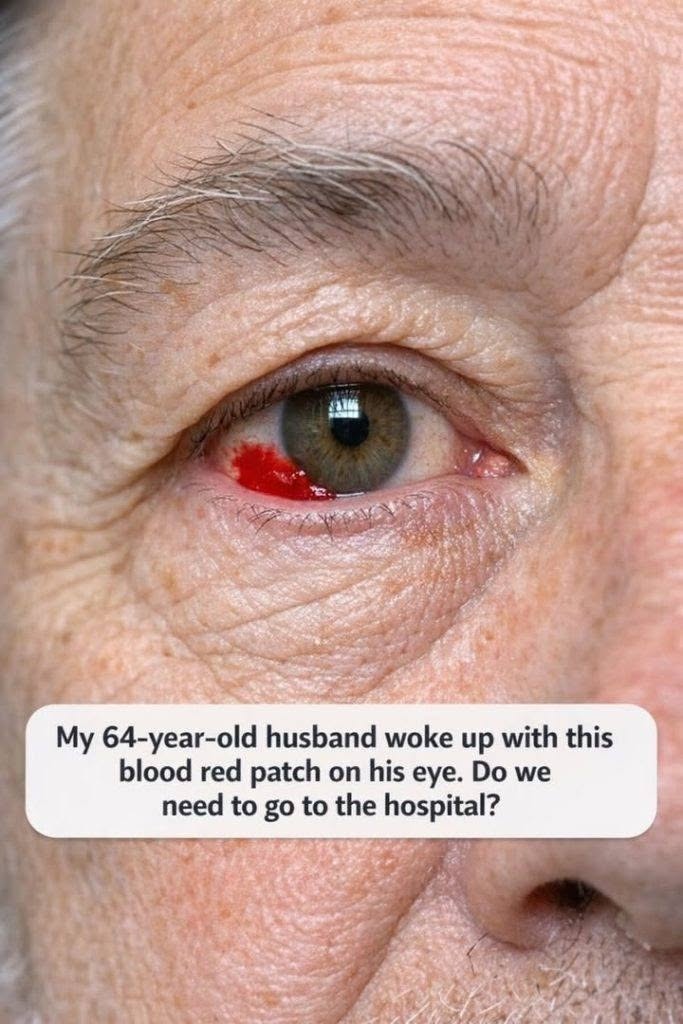
My 64-Year-Old Husband Woke Up With a Blood-Red Patch on His Eye—Do We Need to Go to the Hospital?
Waking up and seeing a bright-red patch covering part of the white of the eye can be frightening—especially when it appears suddenly.
The good news is that, if the patch is on the white part of the eye and there is no pain or change in vision, it is often a subconjunctival hemorrhage, commonly called a broken blood vessel in the eye. It can look dramatic, but the blood is beneath the clear surface membrane of the eye and usually does not affect vision.
Does He Need the Emergency Room?
Not necessarily.
If your husband feels well, has normal vision, no significant eye pain, and there was no injury to the eye, a simple subconjunctival hemorrhage generally does not require emergency treatment. The blood is typically reabsorbed naturally over several days to a few weeks.
However, because he is 64, it is reasonable to have his blood pressure checked, particularly if this has happened before. High blood pressure and other vascular conditions can be associated with these hemorrhages.
When Should You Seek Urgent Medical Care?
Don’t simply assume that every red eye is a harmless broken blood vessel.
He should receive prompt medical evaluation if he has:
- Eye pain
- Blurred, double or suddenly changed vision
- A recent injury or blow to the eye
- Blood appearing in the colored part of the eye or elsewhere inside the eye
- Significant swelling
- Recurrent unexplained episodes
- Other unusual bleeding or easy bruising
Mayo Clinic specifically recommends medical evaluation when a subconjunctival hemorrhage occurs after an eye injury or is accompanied by eye pain or vision changes.
If there is sudden major vision loss, severe eye pain, serious trauma, or a severe sudden headache with neurological symptoms, treat that as an emergency and seek immediate emergency care.
What Can Cause a Broken Blood Vessel?
Sometimes there is no obvious cause.
A subconjunctival hemorrhage can occur after coughing, sneezing, vomiting, straining, lifting something heavy or rubbing the eye. It can also occur spontaneously.
Certain medications and medical conditions can also increase the tendency to bleed, so recurrent episodes should be discussed with a healthcare professional.
What Can You Do at Home?
If there are no warning signs, there usually isn’t much treatment needed.
If the eye feels irritated, artificial tears may help with comfort. Otherwise, the blood generally clears on its own.
The red area may initially look alarming and can even appear to spread slightly as the blood moves beneath the surface. That does not necessarily mean the condition is getting worse.
The Bottom Line
A blood-red patch on the white of the eye can look terrifying while being relatively harmless.
If your 64-year-old husband has normal vision, no significant pain, and no recent eye injury, a broken surface blood vessel is a common possibility and usually does not require a trip to the emergency room.
But if he has pain, vision changes, trauma, unusual bleeding, or other concerning symptoms, he should be evaluated promptly rather than assuming it is simply a broken blood vessel.
When it comes to the eyes, appearance alone isn’t enough—symptoms such as pain and vision changes are important clues.