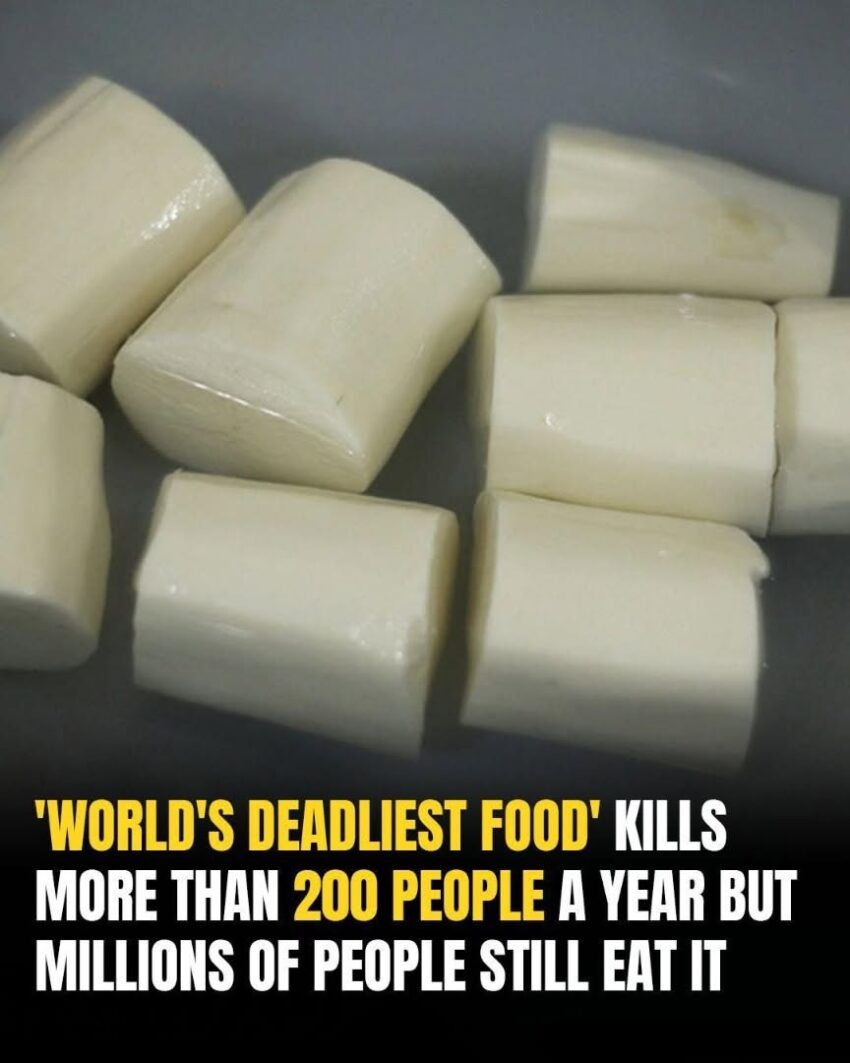
Over 200 People Are Killed by the “World’s Deadliest Food” Every Year But Almost 500 Million People Still Eat It
It looks harmless.
It grows underground.
It can be boiled, fried, dried, fermented, ground into flour, or turned into countless traditional foods.
And for hundreds of millions of people around the world, it is an essential source of calories.
But there is something unusual about this humble root.
If prepared incorrectly, it can release cyanide.
The food is cassava, also known as yuca, manioc, or tapioca root.
And although headlines sometimes call it the “world’s deadliest food,” cassava is not inherently poisonous. The real danger comes from naturally occurring compounds in the plant that can produce cyanide when the food is improperly processed.
So why do hundreds of millions of people continue to eat it?
Because when properly processed, cassava is an important and versatile staple.
What Exactly Is Cassava?
Cassava is a starchy root crop originally from South America.
Today, it is widely grown and eaten throughout tropical regions, particularly in Africa, Asia, and Latin America.
Historical scientific literature estimates that cassava provides energy to around 500 million people, while World Health Organization research notes that about 200 million people derive a substantial portion of their daily calories from it.
It is popular for a simple reason:
Cassava is remarkably resilient.
It can grow in relatively poor soils and withstand conditions in which some other crops struggle.
For communities that depend heavily on agriculture, that reliability can be extremely important.
But cassava has a hidden defense mechanism.
The Poison Hidden Inside
Cassava contains naturally occurring compounds called cyanogenic glycosides, particularly linamarin and lotaustralin.
Under certain conditions, these compounds can break down and release hydrogen cyanide.
That’s the same chemical family of poison that gives cassava its frightening reputation.
The amount varies depending on the variety of cassava and other factors.
This is why simply looking at a root doesn’t tell you whether it contains a dangerous amount of cyanogenic compounds.
And that’s where traditional food preparation becomes crucial.
How Can Something Dangerous Become Safe to Eat?
For generations, communities that rely on cassava have developed processing methods designed to reduce its cyanide content.
Depending on the variety and the traditional food being made, processing can involve steps such as peeling, soaking, grating, fermenting, drying, and cooking.
These aren’t meaningless culinary traditions.
They can be important food-safety practices.
Scientific research has found that traditional processing techniques can substantially reduce cyanogenic compounds in cassava.
That’s why properly prepared cassava can be a normal part of a healthy diet for millions of people.
The danger comes when important processing steps are skipped, shortened, or performed inadequately.
What Happens If Cassava Is Prepared Incorrectly?
High exposure to cyanide can cause serious poisoning.
Symptoms can include headache, dizziness, nausea, weakness, confusion, breathing difficulties, seizures, and, in severe cases, death.
Long-term or repeated exposure to cyanogenic compounds has also been associated with neurological disorders in populations that rely heavily on inadequately processed cassava.
The World Health Organization has reported that cassava poisoning causes more than 200 deaths annually, while many more people may suffer serious health effects from lower-level exposure.
That number sounds shocking until you remember the scale of cassava consumption.
Hundreds of millions of people depend on this crop.
The risk is therefore not simply, “cassava is deadly.”
It’s more accurately:
Cassava can become dangerous when its natural toxins aren’t adequately removed.
Why Would Anyone Keep Eating It?
Because the benefits are enormous.
Cassava is inexpensive in many regions, provides substantial carbohydrates, can produce good yields, and is relatively tolerant of difficult growing conditions.
For millions of households, telling people simply to stop eating cassava would be unrealistic.
Instead, the important issue is safe processing.
This is a good example of how food safety isn’t always about avoiding a food completely.
Sometimes it’s about understanding the food.
Beans, for example, also contain naturally occurring compounds that require proper cooking.
Certain mushrooms can be poisonous.
Some seafood contains powerful toxins.
And cassava contains cyanogenic compounds that need to be reduced through appropriate preparation.
Nature doesn’t always label its hazards.
The “Deadliest Food” Label Can Be Misleading
Calling cassava the “world’s deadliest food” makes for a dramatic headline.
But it can also create the wrong impression.
Cassava isn’t a food that routinely kills people simply because they eat it.
Millions of people consume properly processed cassava safely.
The real problem is improper processing and high cyanide exposure.
So if you’ve eaten cassava before, there is no reason to panic.
The important lesson is simply to treat the raw crop with respect and follow established food-safety practices.
If you’re unfamiliar with preparing cassava, use preparation guidance from a reputable food-safety or public-health authority rather than experimenting with raw or inadequately processed roots.
A Staple With a Hidden Lesson
Cassava is a fascinating reminder that food can be more complicated than it looks.
The same plant can be:
A vital source of food.
An important agricultural crop.
And, if improperly processed, a potential source of poisoning.
That isn’t a contradiction.
It’s the reality of many traditional foods.
For hundreds of millions of people, cassava isn’t some mysterious “deadly food.”
It’s dinner.
It’s flour.
It’s a source of income.
It’s part of their culture.
And it’s a crop that has helped people survive difficult agricultural conditions for generations.
The danger lies not in the existence of cassava, but in forgetting that proper preparation matters.
So the next time you hear someone call cassava the “world’s deadliest food,” remember the bigger story.
It isn’t a poisonous root that somehow millions of people are foolish enough to eat.
It’s a remarkably useful staple with a natural toxin that humans have learned to manage through careful processing.
And that may be the most interesting thing about cassava of all.